Fall Lawn Care Checklist: What to Do Before Winter
A step-by-step fall lawn care checklist: final mowing height, leaves, winterizer feeding, aeration and overseeding, split by cool-season and warm-season grass.
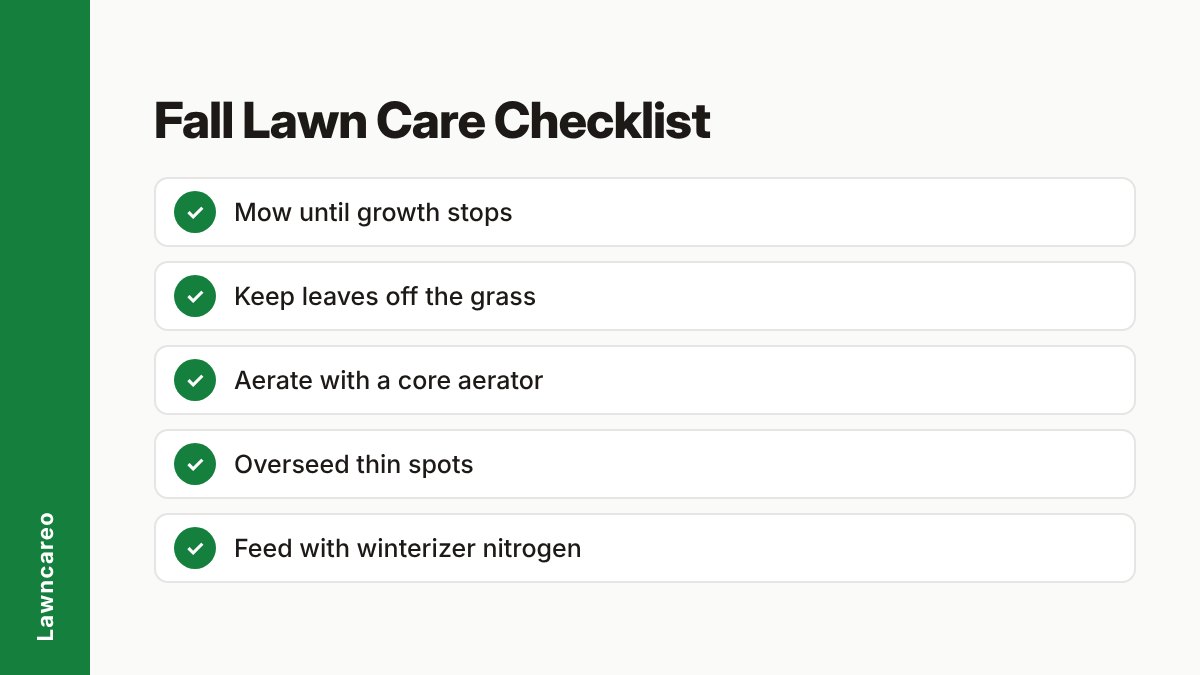
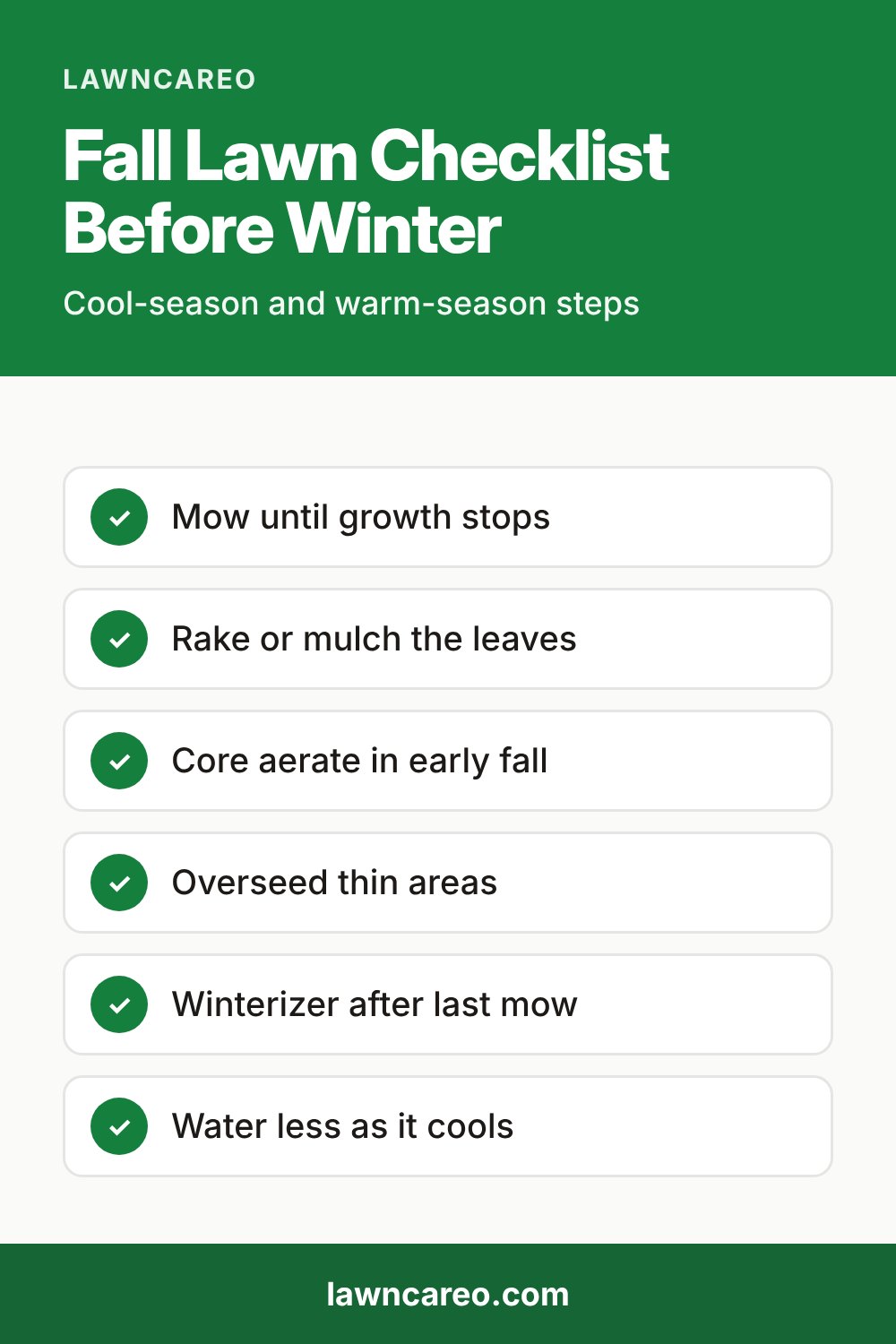
The best fall lawn care checklist depends on your grass type. Cool-season grasses (bluegrass, fescue, ryegrass) get their biggest boost in fall: keep mowing until growth stops, manage leaves, aerate and overseed, then apply a winterizer feeding after the last cut. Warm-season grasses (Bermuda, zoysia, centipede) are heading for dormancy, so they need less feeding and more preparation for winter weeds.
Quick answer
- Cool-season lawn: mow until growth stops, keep leaves off the grass, aerate and overseed in early fall, feed once in mid-September and again after the last mow if your local extension recommends it.
- Warm-season lawn: make the last nitrogen application in August, lower the mower to normal height, apply a pre-emergent herbicide before nights drop below 60°F, and test the soil.
- Both: water about 1 inch per week while the grass is growing, then taper off as temperatures fall.
Timing varies by region. The dates below come from university extension services in Iowa, Utah and Georgia, so use them as a pattern and check your own state’s extension office for local dates.
Cool-season vs warm-season: what changes
| Task | Cool-season grass | Warm-season grass |
|---|---|---|
| Nitrogen feeding | Mid-September, up to 1 lb N per 1,000 sq ft; winterizer after last mow in late October or early November (Utah) | Last application in August; none in September |
| Mowing height | Keep 2.5 to 3 in or taller in season; final cuts vary by region | Keep 1 to 2 in (Bermuda, centipede, zoysia) |
| Aeration | Early September (Iowa); September or October (Utah) | Not a fall task: aerate in late spring or early summer, while the grass is growing (UGA) |
| Overseeding | Mid-August to mid-September (Iowa); September to October (Utah) | Not a fall task: seed or lay sod in late spring or summer |
| Weed control | Broadleaf herbicides late September to early November | Pre-emergent in September or before nights fall below 60°F |
What you need
- A mower with a sharp blade and adjustable height
- A rake, leaf blower or mulching mower
- A core aerator (rental centers carry them) and a drop or broadcast spreader
- Lawn fertilizer, and grass seed matched to your existing lawn if overseeding
- A soil test kit or lab submission bag from your extension office
Wear closed shoes, eye protection and hearing protection around power equipment. Keep children and pets away from the area during mowing and aeration, and read the label on any fertilizer or herbicide before you use it.
Step-by-step fall checklist
1. Keep mowing until growth stops
Both Iowa State and Utah State advise continuing to mow until the grass stops growing, which in Iowa is usually late October or early November when daytime highs stay below 50°F. Never remove more than one-third of the leaf blade in one mowing.
Final height is where advice differs. Iowa State suggests raising the cut from about 3 to 3.5 in down to 2.5 to 3 in in mid to late September. Utah State suggests a final cut of about 1.5 to 2 in with clippings bagged or removed. Pick the approach your local extension recommends, and avoid scalping.
2. Manage the leaves
Leaves that block light cause dieback and bare patches, so remove them before they mat down. You have three options: rake, blow or bag them for compost, or chop them with the mower.
Mulching works best when leaves are thin and dry. Utah State suggests mulching them in with the mower when the layer is 1 to 2 inches deep or less, and repeating through the fall. If the shredded leaves start to shade the grass, rake them off and use them elsewhere in the garden.
3. Aerate (cool-season lawns)
Early September is the best time for core aeration in Iowa, and Utah State lists September and October as good months. Most home lawns need aeration once a year or less, though heavily used lawns and clay soils may need it more often.
- Water the lawn a day or two beforehand so the soil is moist but not soggy.
- Use a core aerator that pulls plugs about 3/4 in wide and 3 in long. Spike aerators can compact soil further.
- Make several passes to reach roughly 20 to 40 holes per square foot.
- Break up the cores by dragging a mat or weighted fencing across the lawn.
4. Overseed thin areas (cool-season lawns)
Iowa State gives mid-August to mid-September for renovating thin lawns, and Utah State lists September and October. Seed needs soil contact, which is why aerating first helps.
- Mow low (1.5 to 2 in) before seeding.
- Aerate, or use a slit seeder or vertical mower, so seed reaches the soil.
- Spread seed at the rate on the bag label.
- Keep the top inch of soil moist until seedlings are 1 to 2 in tall, then water less often but more deeply.
For brand-new lawns, Iowa State suggests covering seed 1/8 to 1/4 in deep and mulching lightly with weed-free straw.
5. Feed the lawn
For cool-season grass, Iowa State recommends fertilizing in mid-September at no more than 1 lb of actual nitrogen per 1,000 sq ft. Utah State describes a separate winterizer feeding in late October or early November, after the last mowing, using a quick-release nitrogen product at about 1 lb of nitrogen per 1,000 sq ft. The bag shows three numbers (N-P-K), and a 20-0-0 product contains only nitrogen. Utah State notes that its lawns usually need only nitrogen and recommends a soil test before adding phosphorus or potassium.
For warm-season grass, the UGA Extension advice is different: make the last nitrogen application in August. Fertilizing in September can delay dormancy and increase the risk of cold injury. Apply no fertilizer after August, though in September a pre-emergent product with potassium (such as a 0-0-7) can help bermudagrass winter hardiness.
6. Control weeds
Cool-season lawns: perennial broadleaf weeds move food to their roots in fall, so Iowa State recommends applying broadleaf herbicides from late September to early November. Common active ingredients include 2,4-D, MCPP, dicamba and triclopyr, and blends usually work best. Follow every direction on the label.
Warm-season lawns: apply a pre-emergent herbicide in September, or before nighttime temperatures drop below 60°F, to stop winter weed seeds from germinating. Products containing atrazine are not for bermudagrass.
7. Water, then taper off
Lawns need about 1 inch of water per week during active growth, including rain. Water deeply and infrequently, and check the lawn by walking on it: footprints that stay mean it needs water. As temperatures drop, reduce irrigation rather than keeping the summer schedule. Newly seeded or sodded areas need the most attention.
8. Test the soil
UGA Extension recommends taking a soil sample in September, since fall is also a good time to apply lime if the test calls for it. A lab report removes the guesswork about phosphorus, potassium and pH.
Common mistakes
| Mistake | Why it matters | Better approach |
|---|---|---|
| Feeding warm-season grass in September | Can delay dormancy and risk cold injury | Last nitrogen in August |
| Letting leaves pile up | Blocks light, causes dieback and bare patches | Rake or mulch regularly |
| Using a spike aerator | Can compact soil | Use a core aerator |
| Cutting too much at once | Stresses the grass | Remove no more than one-third of the blade |
| Seeding without soil contact | Seed fails to establish | Aerate or slit-seed first |
| Skipping the soil test | You may add nutrients you do not need | Test before applying phosphorus or potassium |
When to call a professional
Consider a lawn care or irrigation professional if large areas stay thin after overseeding, if you see widespread dead circles that may be disease, if drainage leaves water standing, or if you need to apply restricted-use products. Your local extension office can also help with diagnosis and soil testing.
Sources
Frequently asked questions
What is the last thing to do to your lawn before winter?
For cool-season grass, the last job is usually a winterizer feeding after the final mowing, in late October or early November in northern climates. Warm-season lawns get no more nitrogen after August, so their last jobs are the final mow and a pre-emergent weed treatment.
Should I rake leaves or leave them on the lawn?
Do not let a thick layer sit on the grass, because it blocks light and causes dieback and bare patches. Thin, dry leaves can be chopped with the mower and left to fall between the blades; thicker layers should be raked or bagged.
Is fall a good time to aerate and overseed?
Yes for cool-season lawns. Early September to October is a common window, and aerating just before overseeding helps seed touch the soil. Warm-season lawns follow a different calendar.
How short should I cut the grass for the last mow?
It depends on the source and the region. Utah State suggests a final cut of about 1.5 to 2 inches for cool-season grass, while Iowa State suggests easing the height down to 2.5 to 3 inches in fall. Check your local extension office for your area.